¿Sabes decir que algo es más grande, más barato o el mejor de todos en inglés? Los comparativos y superlativos en inglés son una de las herramientas más útiles del idioma: los usas para dar opiniones, elegir productos, describir personas, comparar ciudades y hablar de tus experiencias.
La buena noticia es que las reglas son más simples de lo que parecen. En esta guía vas a aprender cómo formar comparativos y superlativos paso a paso, cuándo usar -er/-est y cuándo more/most, cuáles son los adjetivos irregulares y cómo evitar los errores más comunes de los hispanohablantes. Al final tienes ejercicios con respuestas y una tabla resumen para guardar.
Tip: Guarda esta página en favoritos. Es una guía de consulta rápida para cuando dudes entre bigger, more big o most biggest.
Índice de contenidos
- ¿Qué son los comparativos y superlativos en inglés?
- Regla de oro: cuántas sílabas tiene el adjetivo
- Comparativos: reglas y ejemplos
- Superlativos: reglas y ejemplos
- Cambios de ortografía que debes conocer
- Adjetivos irregulares (los que debes memorizar)
- Comparaciones de igualdad: as… as
- Comparaciones de inferioridad: less y the least
- Cómo reforzar o suavizar un comparativo
- Estructuras avanzadas: the more… the more
- Comparativos y superlativos con adverbios
- 8 errores comunes
- Pronunciación
- Ejercicios prácticos con respuestas
- Preguntas frecuentes
- Conclusión
¿Qué son los comparativos y superlativos en inglés?
- El comparativo compara dos cosas, personas o ideas: My car is faster than your car. (Mi auto es más rápido que el tuyo.)
- El superlativo destaca algo por encima de tres o más, o de todo un grupo: This is the fastest car in the world. (Este es el auto más rápido del mundo.)
| Grado | Función | Ejemplo |
|---|---|---|
| Positivo | Describe, sin comparar | The movie is good. |
| Comparativo | Compara dos elementos | The book is better than the movie. |
| Superlativo | Destaca el extremo de un grupo | It’s the best book I’ve ever read. |
Regla de oro: cuántas sílabas tiene el adjetivo
Todo depende del número de sílabas. Memoriza esta tabla y ya tienes el 80% del tema resuelto:
| Tipo de adjetivo | Comparativo | Superlativo | Ejemplo |
|---|---|---|---|
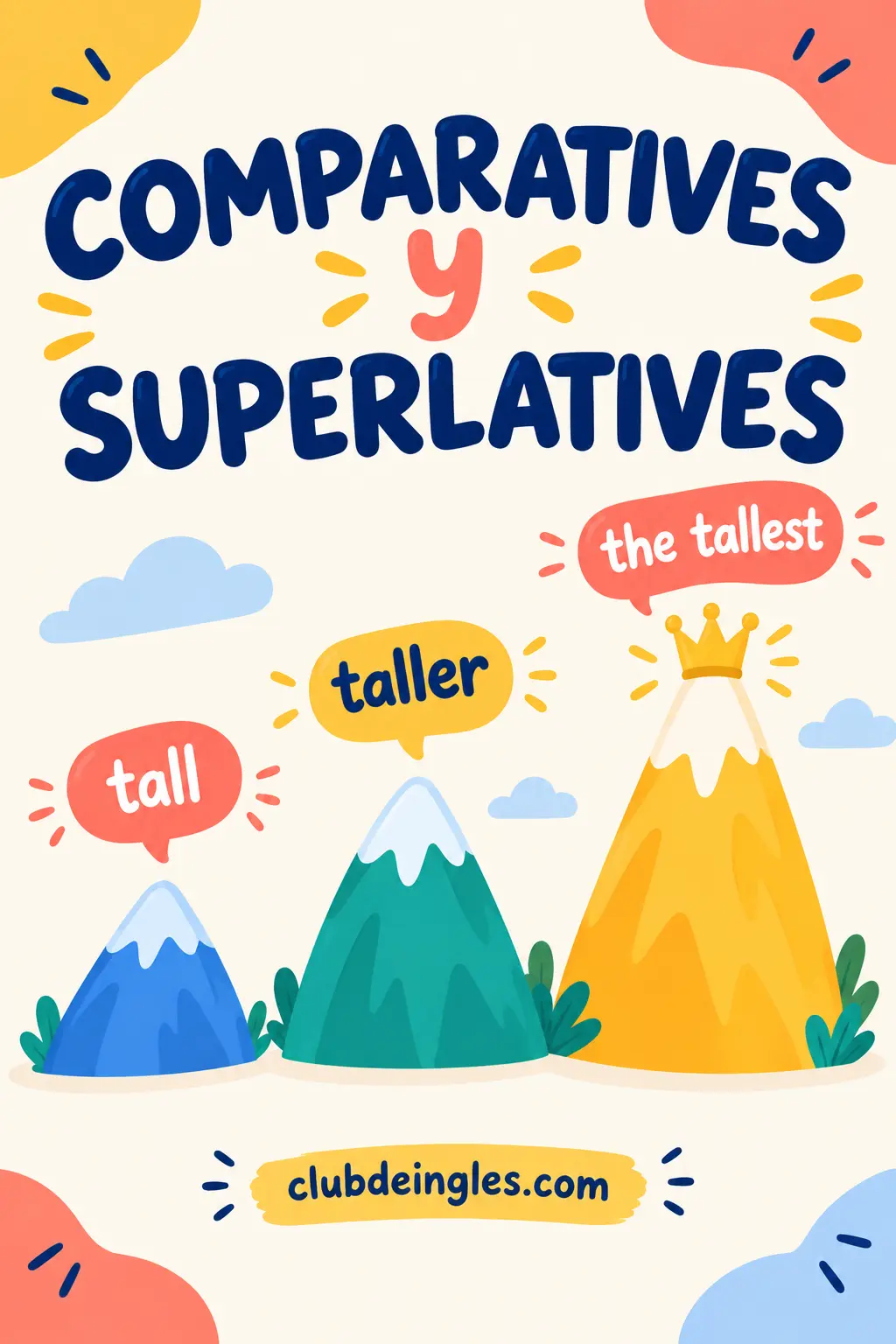
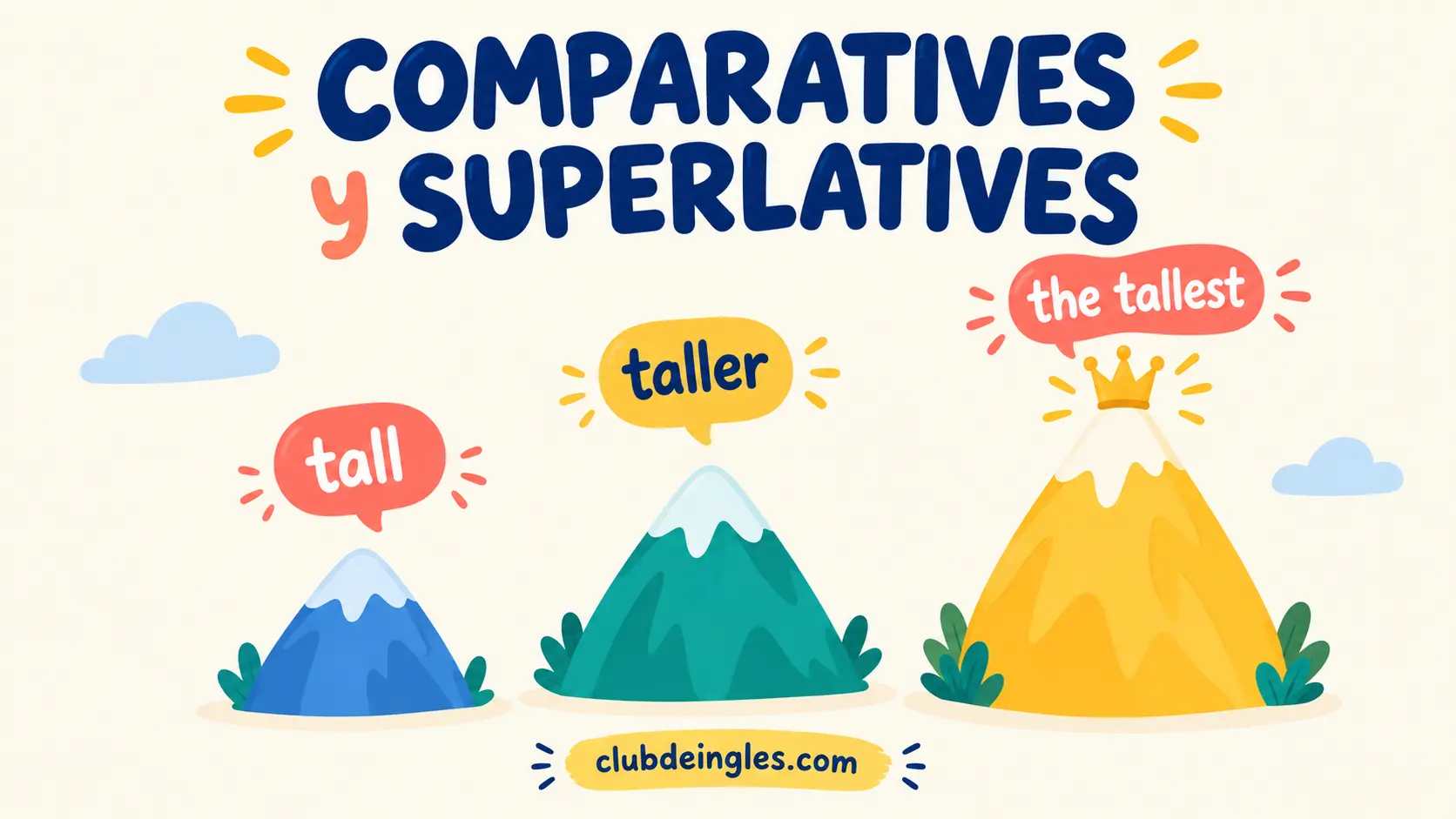
| 1 sílaba | adjetivo + -er | the + adjetivo + -est | tall → taller → the tallest |
| 2 sílabas terminadas en -y | quita la y + -ier | the + quita la y + -iest | happy → happier → the happiest |
| 2 sílabas (otras) o más | more + adjetivo | the most + adjetivo | beautiful → more beautiful → the most beautiful |
Comparativos: reglas y ejemplos
Estructura básica
Sujeto + verbo + comparativo + THAN + segundo elemento
- Santiago is bigger than Valparaíso.
- English is easier than I thought.
- This laptop is more expensive than that one.
- My sister is taller than me.
⚠️ En inglés se usa than (no that, ni then) para comparar. Esta confusión es muy frecuente.
Adjetivos de una sílaba: añade -er
| Adjetivo | Comparativo |
|---|---|
| cheap (barato) | cheaper |
| fast (rápido) | faster |
| old (viejo) | older |
| small (pequeño) | smaller |
| cold (frío) | colder |
Adjetivos largos: usa MORE
| Adjetivo | Comparativo |
|---|---|
| interesting | more interesting |
| difficult | more difficult |
| comfortable | more comfortable |
| expensive | more expensive |
| dangerous | more dangerous |
Superlativos: reglas y ejemplos
Estructura básica
Sujeto + verbo + THE + superlativo + (in / of) + grupo
- Mount Aconcagua is the highest mountain in the Americas.
- She is the most intelligent student in the class.
- This is the cheapest restaurant in town.
- July is the coldest month of the year.
¿In u of después del superlativo?
- Usa in con lugares o grupos: the biggest city in Chile, the best player in the team.
- Usa of con periodos de tiempo o conjuntos de elementos: the best day of my life, the tallest of the three.
Superlativo con present perfect
Una estructura muy natural para hablar de experiencias:
- It’s the best movie I’ve ever seen.
- That was the worst meal I’ve ever had.
One of the + superlativo + plural
Para decir «uno de los más…»:
- Valparaíso is one of the most beautiful cities in Chile.
- She is one of the best teachers I know.
Cambios de ortografía que debes conocer
| Regla | Ejemplo |
|---|---|
| Si termina en -e, solo añade -r / -st | large → larger → the largest |
| Si termina en consonante-vocal-consonante, duplica la consonante final | big → bigger → the biggest |
| Si termina en -y, cambia la y por -ier / -iest | easy → easier → the easiest |
| Si termina en -w o -x, no se duplica | new → newer → the newest |
Otros ejemplos con duplicación: hot → hotter → the hottest, thin → thinner → the thinnest, fat → fatter → the fattest.
Adjetivos irregulares (los que debes memorizar)
Estos adjetivos no siguen ninguna regla. Son pocos, pero son de los más usados:
| Adjetivo | Comparativo | Superlativo | Ejemplo |
|---|---|---|---|
| good | better | the best | This pizza is better than that one. |
| bad | worse | the worst | The traffic today is worse than yesterday. |
| far | farther / further | the farthest / the furthest | The beach is farther than I expected. |
| little | less | the least | I have less time than you. |
| much / many | more | the most | She has the most experience. |
| old | older / elder* | the oldest / the eldest* | He is my older brother. |
*Elder y eldest se usan casi solo para familiares: my elder sister.
Adjetivos de dos sílabas que aceptan ambas formas
Algunos adjetivos admiten -er/-est y more/most:
- clever → cleverer / more clever
- simple → simpler / more simple
- quiet → quieter / more quiet
- narrow → narrower / more narrow
- gentle → gentler / more gentle
Si dudas, la forma con -er/-est suele sonar más natural.
Comparaciones de igualdad: as… as
Cuando dos cosas son iguales, usa as + adjetivo + as:
- My brother is as tall as my father. (Mi hermano es tan alto como mi padre.)
- This test was as easy as the last one.
Para decir que no son iguales, usa not as… as o not so… as:
- English is not as difficult as I thought.
- This phone is not as expensive as that one.
Otras estructuras de igualdad y diferencia
- the same as: My phone is the same as yours.
- different from (o different than en inglés americano): Chile is different from Argentina.
- similar to: Your accent is similar to mine.
Comparaciones de inferioridad: less y the least
Para decir «menos», usa less (comparativo) y the least (superlativo). Funcionan con cualquier adjetivo, sin importar las sílabas:
- This course is less expensive than the other one.
- This is the least expensive option.
- Cats are less noisy than dogs.
Ojo: con sustantivos contables, el inglés formal prefiere fewer (fewer people) y con incontables less (less water).
Cómo reforzar o suavizar un comparativo
Puedes cambiar la fuerza de la comparación con estas palabras:
| Para reforzar (mucho más) | Para suavizar (un poco más) |
|---|---|
| much | a bit |
| far | a little |
| a lot | slightly |
| significantly | somewhat |
- This car is much faster than that one.
- She is a lot more experienced than me.
- Today is a bit colder than yesterday.
- The new model is slightly cheaper.
⚠️ No uses very con comparativos: ❌ very bigger → ✅ much bigger.
Estructuras avanzadas: the more… the more
Comparativo doble (cada vez más)
Para expresar un cambio progresivo, repite el comparativo:
- The weather is getting colder and colder.
- English is becoming more and more important.
- My English is getting better and better.
The + comparativo, the + comparativo
Para expresar causa y efecto («cuanto más… más…»):
- The more you practice, the better you speak.
- The earlier you arrive, the more time you have.
- The sooner, the better. (Cuanto antes, mejor.)
Comparativos y superlativos con adverbios
Los adverbios también se comparan:
- Adverbios cortos (fast, hard, early, late) → -er / -est: She runs faster than me. / He works the hardest.
- Adverbios terminados en -ly → more / most: Please speak more slowly. / She drives the most carefully.
- Irregular: well → better → the best; badly → worse → the worst.
8 errores comunes
1. Usar -er y more a la vez
❌ more bigger ✅ bigger
2. Usar -est y most a la vez
❌ the most easiest ✅ the easiest
3. Olvidar THE en el superlativo
❌ She is most intelligent student. ✅ She is the most intelligent student.
4. Usar that o then en vez de than
❌ My house is bigger that yours. ✅ My house is bigger than yours.
5. Olvidar duplicar la consonante
❌ biger, hoter ✅ bigger, hotter
6. Decir «more good» o «more bad»
❌ more good, the most bad ✅ better, the worst
7. Usar in en vez de of (o al revés)
❌ the best day in my life ✅ the best day of my life
8. Usar very con un comparativo
❌ very better ✅ much better
Pronunciación
- La terminación -er se pronuncia con un sonido débil, «er» suave: taller /ˈtɔːlər/. No pronuncies la r final como una r fuerte española.
- La terminación -est es débil: tallest /ˈtɔːlɪst/. En conversación rápida, the se pronuncia /ðə/ y se une con el adjetivo.
- Than casi siempre es débil: /ðən/, como «dan» con la lengua entre los dientes.
- En more, el acento está en el adjetivo siguiente: more BEAUtiful.
Mini diálogo de práctica
Lee este diálogo en voz alta y subraya todos los comparativos y superlativos:
A: Which phone should I buy? This one is cheaper, but that one is more modern. B: The red one is the best in the store, but it’s much more expensive than the others. A: Is it as good as the blue one? B: It’s better! It has the longest battery life and the sharpest camera. A: The more I think about it, the more I want it. B: Then buy it! It’s the best decision you can make.
Ejercicios prácticos con respuestas
1. Escribe el comparativo
- fast → ______
- beautiful → ______
- happy → ______
- good → ______
- big → ______
- expensive → ______
- bad → ______
- easy → ______
2. Escribe el superlativo
- tall → ______
- interesting → ______
- hot → ______
- far → ______
- funny → ______
- important → ______
Ejercicio 3: Completa la oración
- My brother is ______ (tall) than me.
- This is ______ (good) restaurant in the city.
- English is ______ (difficult) than I expected.
- Today is ______ (hot) day of the year.
- She is not ______ (old) as my sister.
- This exercise is ______ (easy) of all.
Ejercicio 4: Corrige el error
- This house is more bigger than mine.
- He is the most tallest boy in the class.
- She is more good than me at tennis.
- It’s the best day in my life.
- My car is faster that yours.
Respuestas
1. 1. faster · 2. more beautiful · 3. happier · 4. better · 5. bigger · 6. more expensive · 7. worse · 8. easier
2. 1. the tallest · 2. the most interesting · 3. the hottest · 4. the farthest / the furthest · 5. the funniest · 6. the most important
3. 1. taller · 2. the best · 3. more difficult · 4. the hottest · 5. as old · 6. the easiest
4.
- This house is bigger than mine.
- He is the tallest boy in the class.
- She is better than me at tennis.
- It’s the best day of my life.
- My car is faster than yours.
Preguntas frecuentes sobre comparativos y superlativos en inglés
¿Cuándo se usa -er y cuándo more?
Usa -er con adjetivos de una sílaba (taller) y de dos sílabas terminados en -y (happier). Usa more con adjetivos de dos sílabas o más (more beautiful).
¿Se puede usar more con un adjetivo corto?
No en general. More tall suena incorrecto; lo natural es taller. Solo algunos adjetivos de dos sílabas aceptan ambas formas, como clever o quiet.
¿Por qué el superlativo lleva «the»?
Porque el superlativo identifica un elemento único dentro de un grupo, y en inglés lo único lleva artículo definido: the tallest, the most interesting.
¿Cuál es la diferencia entre farther y further?
Farther se usa sobre todo para distancia física (The beach is farther). Further se usa para distancia física o abstracta (We need further information), y es muy común en inglés británico.
¿Cómo se dice «tan… como» en inglés?
Con la estructura as + adjetivo + as: She is as smart as her brother.
¿Cómo se dice «el más… de todos»?
Con the + superlativo + of all o the + superlativo + in/of + grupo: She is the best of all.
Tabla resumen: tu cheat sheet
| Situación | Regla | Ejemplo |
|---|---|---|
| Adjetivo de 1 sílaba | + er / the + est | cold → colder → the coldest |
| Termina en -e | + r / + st | nice → nicer → the nicest |
| CVC (consonante-vocal-consonante) | duplica + er / est | big → bigger → the biggest |
| 2 sílabas en -y | -ier / -iest | easy → easier → the easiest |
| 2+ sílabas | more / the most | difficult → more difficult → the most difficult |
| Irregulares | memorizar | good → better → the best |
| Igualdad | as… as | as tall as |
| Inferioridad | less / the least | less expensive → the least expensive |
| Comparar | than | taller than |
| Superlativo + lugar o grupo | in / of | the best in the class |
Conclusión
Dominar los comparativos y superlativos en inglés te permite expresar opiniones, tomar decisiones y describir el mundo con precisión. Recuerda tres ideas clave:
- Cuenta las sílabas: -er/-est para las cortas, more/most para las largas.
- Memoriza los irregulares: good, bad, far, little, much.
- No olvides than en el comparativo y the en el superlativo.
Empieza hoy: escribe cinco comparaciones sobre tu ciudad, tu familia o tus cosas favoritas, por ejemplo: My city is bigger than…, My phone is the best…. En una semana notarás la diferencia.
¿Qué parte te cuesta más: las irregulares o decidir entre -er y more? Cuéntamelo en los comentarios. Y si te sirvió esta guía, compártela con alguien que esté aprendiendo inglés.