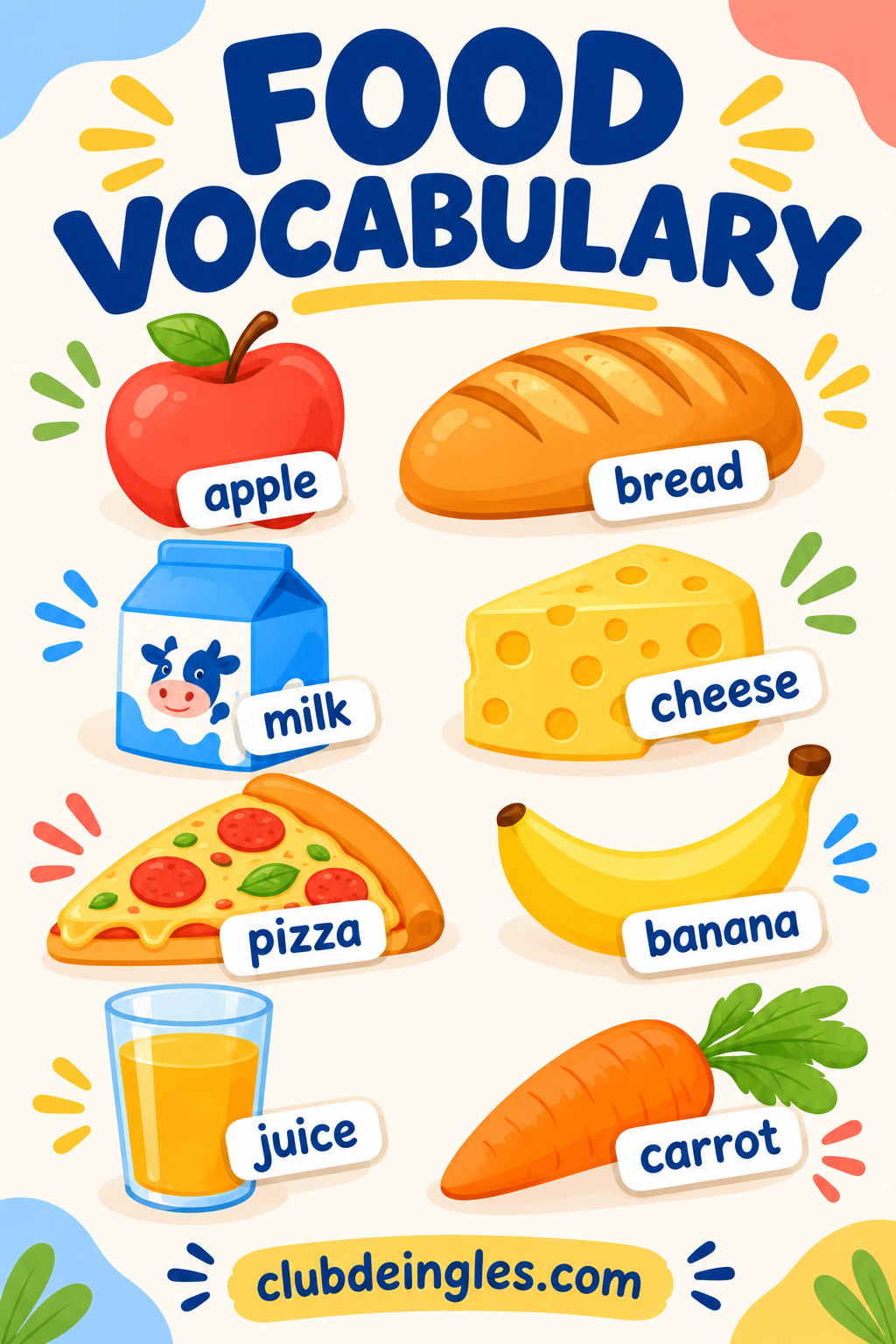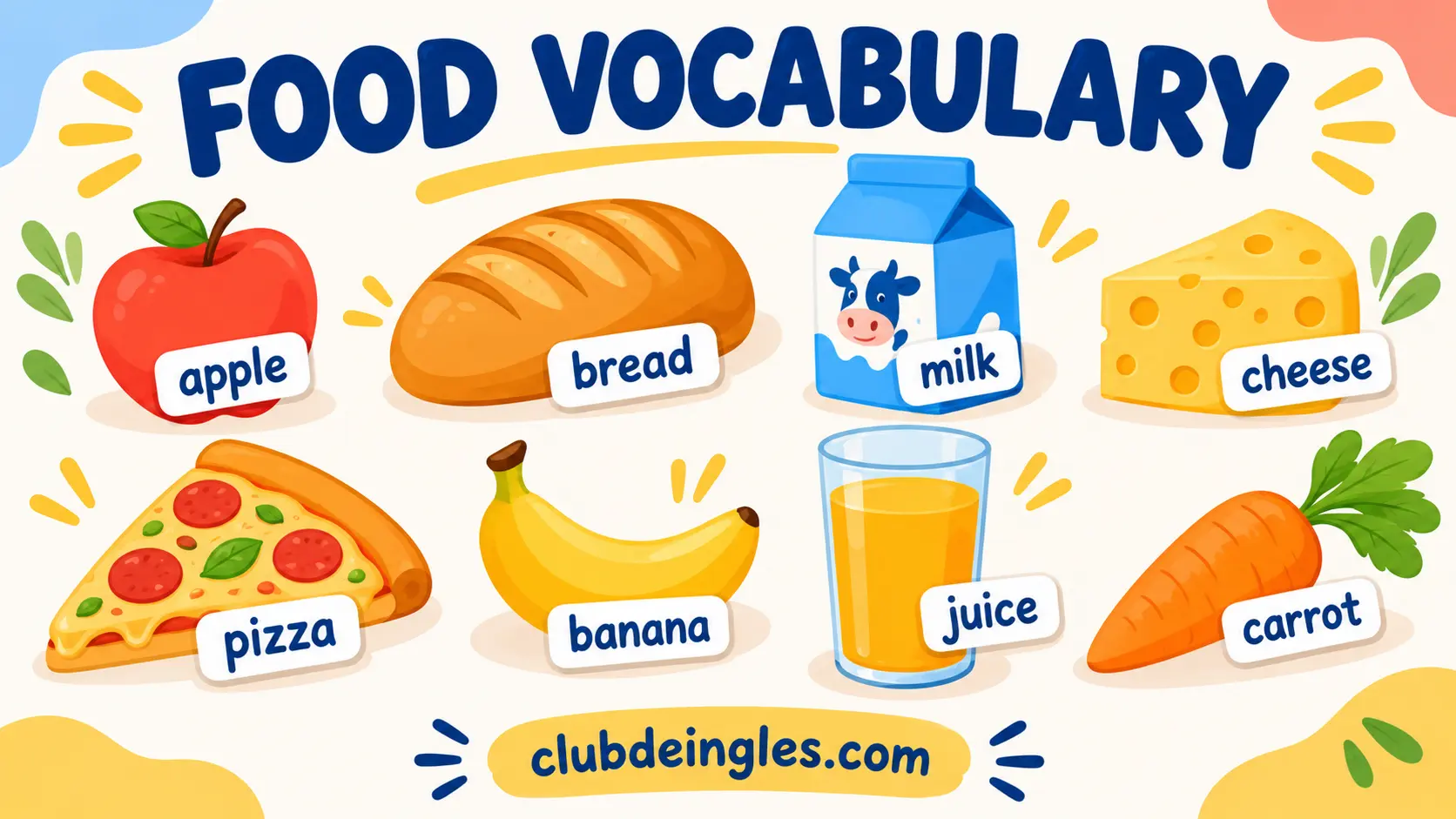
¿Sabes pedir un café con leche en inglés? ¿Puedes leer un menú, hacer la lista del supermercado o decir qué te gusta comer? El vocabulario de comida en inglés es uno de los más útiles para viajar, conocer gente, ir a restaurantes y hablar de tu día a día.
En esta guía vas a aprender más de 150 palabras de comida y bebida en inglés, organizadas por categorías, con su significado en español y ejemplos. Además, verás cómo hablar de las comidas del día, cómo pedir en un restaurante, cómo usar cantidades (a slice of, a bottle of), qué palabras son contables o incontables y qué errores evitar. Al final tienes ejercicios con respuestas y un cheat sheet para repasar.
Tip: Guarda esta página en favoritos. Estudia una categoría por día y, en una semana, tendrás un vocabulario sólido.
Índice de contenidos
- Frutas (fruits)
- Verduras y hortalizas (vegetables)
- Carnes, pescados y mariscos (meat and seafood)
- Lácteos y huevos (dairy and eggs)
- Pan, cereales y granos (bread, cereals and grains)
- Bebidas (drinks)
- Dulces, postres y snacks (sweets, desserts and snacks)
- Condimentos, salsas y especias (condiments and spices)
- Las comidas del día (meals)
- Verbos de cocina y comida
- Sabores y adjetivos para describir la comida
- Cantidades y envases: a slice of, a bottle of
- Contables e incontables: a, an, some, any
- En el restaurante: frases clave
- En el supermercado
- Diferencias entre inglés británico y americano
- Pronunciación de palabras difíciles
- Utensilios y vajilla
- 8 errores comunes
- Ejercicios prácticos con respuestas
- Preguntas frecuentes
- Conclusión
Frutas (fruits)
| Inglés | Español |
|---|---|
| apple | manzana |
| banana | plátano, banana |
| orange | naranja |
| lemon | limón |
| lime | lima, limón verde |
| strawberry | fresa, frutilla |
| blueberry | arándano |
| grapes | uvas |
| watermelon | sandía |
| melon | melón |
| pineapple | piña, anaá |
| peach | durazno, melocotón |
| pear | pera |
| cherry | cereza |
| mango | mango |
| avocado | palta, aguacate |
| coconut | coco |
| kiwi | kiwi |
| plum | ciruela |
| raspberry | frambuesa |
- I eat an apple every day.
- She likes strawberries with cream.
- Can I have a glass of orange juice, please?
Truco: la palabra general es fruit (incontable): I like fruit. Se dice a piece of fruit para una unidad: I eat a piece of fruit after lunch.
Verduras y hortalizas (vegetables)
| Inglés | Español |
|---|---|
| carrot | zanahoria |
| potato | papa, patata |
| tomato | tomate |
| onion | cebolla |
| garlic | ajo |
| lettuce | lechuga |
| cucumber | pepino |
| pepper | pimiento (y también pimienta) |
| broccoli | brócoli |
| spinach | espinaca |
| cabbage | repollo, col |
| cauliflower | coliflor |
| corn | choclo, maíz |
| peas | arvejas, guisantes |
| beans | porotos, frijoles, judías |
| mushroom | champiñón, hongo |
| pumpkin | zapallo, calabaza |
| celery | apio |
| eggplant (US) / aubergine (UK) | berenjena |
| zucchini (US) / courgette (UK) | zapallo italiano, calabacín |
- I put tomatoes and lettuce in my sandwich.
- Eat your vegetables!
- Do you like mushrooms on your pizza?
Carnes, pescados y mariscos (meat and seafood)
| Inglés | Español |
|---|---|
| meat | carne |
| beef | carne de res, vacuno |
| pork | cerdo |
| chicken | pollo |
| turkey | pavo |
| lamb | cordero |
| ham | jamón |
| bacon | tocino, panceta |
| sausage | salchicha, longaniza |
| steak | bistec, filete |
| fish | pescado |
| salmon | salmón |
| tuna | atún |
| shrimp (US) / prawn (UK) | camarón, gamba |
| crab | cangrejo |
| lobster | langosta |
| mussels | choritos, mejillones |
| oysters | ostras |
- I don’t eat meat; I’m vegetarian.
- We had grilled salmon for dinner.
- Can I have a ham and cheese sandwich?
Ojo: en inglés, el nombre del animal y el de su carne suelen ser distintos: cow → beef, pig → pork, sheep → lamb (el cordero), deer → venison.
Lácteos y huevos (dairy and eggs)
| Inglés | Español |
|---|---|
| milk | leche |
| cheese | queso |
| butter | mantequilla |
| cream | crema, nata |
| yogurt | yogur |
| ice cream | helado |
| egg | huevo |
| scrambled eggs | huevos revueltos |
| fried eggs | huevos fritos |
| boiled eggs | huevos cocidos |
| omelette | tortilla (de huevo), omelette |
- I drink a glass of milk every morning.
- Would you like scrambled eggs or fried eggs?
- She is allergic to dairy.
Pan, cereales y granos (bread, cereals and grains)
| Inglés | Español |
|---|---|
| bread | pan |
| toast | pan tostado, tostada |
| bun | pan de hamburguesa, bollo |
| rice | arroz |
| pasta | pasta, fideos |
| noodles | fideos, tallarines |
| cereal | cereal |
| oatmeal / oats | avena |
| flour | harina |
| tortilla | tortilla (de maíz o trigo) |
| pizza | pizza |
| sandwich | sándwich |
- I have toast and jam for breakfast.
- We’re having rice and chicken tonight.
- Can I have a sandwich, please?
Bebidas (drinks)
| Inglés | Español |
|---|---|
| water | agua |
| sparkling water | agua con gas |
| juice | jugo, zumo |
| coffee | café |
| tea | té |
| soda (US) / soft drink / fizzy drink (UK) | bebida gaseosa |
| milkshake | batido de leche |
| smoothie | batido de frutas |
| lemonade | limonada |
| beer | cerveza |
| wine | vino |
| red wine / white wine | vino tinto / blanco |
| hot chocolate | chocolate caliente |
- I’d like a cup of coffee, please.
- Do you want some water?
- She drinks tea with milk and sugar.
Dulces, postres y snacks (sweets, desserts and snacks)
| Inglés | Español |
|---|---|
| chocolate | chocolate |
| candy (US) / sweets (UK) | dulces, caramelos |
| cake | torta, pastel |
| cookie (US) / biscuit (UK) | galleta |
| pie | tarta, pay |
| pancakes | panqueques, hot cakes |
| donut | dona |
| chips (US) / crisps (UK) | papas fritas (de bolsa) |
| French fries (US) / chips (UK) | papas fritas (calientes) |
| popcorn | palomitas, cabritas |
| nuts | frutos secos, nueces |
| peanuts | maní, cacahuates |
| honey | miel |
| jam | mermelada |
| dessert | postre |
- Would you like some cake for dessert?
- I love chocolate ice cream.
- We ate popcorn at the movies.
Condimentos, salsas y especias (condiments and spices)
| Inglés | Español |
|---|---|
| salt | sal |
| pepper | pimienta |
| sugar | azúcar |
| oil | aceite |
| olive oil | aceite de oliva |
| vinegar | vinagre |
| mustard | mostaza |
| ketchup | salsa de tomate, kétchup |
| mayonnaise (mayo) | mayonesa |
| sauce | salsa |
| dressing | aliño (para ensaladas) |
| soy sauce | salsa de soya |
| chili / hot sauce | ají / salsa picante |
| cinnamon | canela |
| parsley | perejil |
| cilantro (US) / coriander (UK) | cilantro |
- Could you pass the salt, please?
- I like mustard on my hot dog.
- Add a little olive oil to the salad.
Las comidas del día (meals)
| Inglés | Significado | Ejemplo |
|---|---|---|
| breakfast | desayuno | I have breakfast at 7:30. |
| brunch | desayuno tardío / almuerzo temprano | We have brunch on Sundays. |
| lunch | almuerzo | What’s for lunch? |
| snack | colación, bocadillo | I eat a snack at 4 p.m. |
| dinner | cena (o comida principal) | We have dinner at 8. |
| supper | cena (más informal o regional) | Supper is ready! |
Regla importante: con las comidas no se usa artículo: I have breakfast, We eat lunch, He cooks dinner. (Solo se usa the o a si hablas de una comida en particular: We had a delicious dinner.)
¿Have, eat o drink?
- eat = comer (alimentos): I eat an apple.
- drink = beber: I drink water.
- have = tomar, servirse (sirve para comida, bebida y comidas del día): I have coffee. / I have lunch.
Verbos de cocina y comida
| Verbo | Significado | Ejemplo |
|---|---|---|
| cook | cocinar | She cooks dinner every night. |
| bake | hornear | I bake bread on weekends. |
| boil | hervir | Boil the eggs for ten minutes. |
| fry | freír | Fry the onions in oil. |
| grill | asar a la parrilla | We grill meat on Sundays. |
| roast | asar al horno | I roast chicken with potatoes. |
| chop | picar, cortar | Chop the tomatoes. |
| slice | cortar en rebanadas | Slice the bread. |
| peel | pelar | Peel the potatoes. |
| mix | mezclar | Mix the eggs and flour. |
| stir | revolver, remover | Stir the soup. |
| pour | verter, servir | Pour the milk into the glass. |
| order | pedir (en restaurante) | Can I order now? |
| taste | probar, saber a | Taste this soup. / It tastes great. |
Sabores y adjetivos para describir la comida
| Inglés | Español | Ejemplo |
|---|---|---|
| delicious / tasty | delicioso, sabroso | This pizza is delicious. |
| sweet | dulce | The cake is too sweet. |
| sour | ácido, agrio | Lemons are sour. |
| bitter | amargo | Black coffee is bitter. |
| salty | salado | The soup is too salty. |
| spicy | picante | I love spicy food. |
| bland | soso | The rice is bland. |
| fresh | fresco | These vegetables are fresh. |
| rotten | podrido | The fruit is rotten. |
| raw | crudo | I don’t eat raw fish. |
| crispy / crunchy | crujiente | The chicken is crispy. |
| juicy | jugoso | The steak is juicy. |
| greasy | grasoso | Fast food is greasy. |
| hungry / thirsty | con hambre / con sed | I’m hungry and thirsty. |
| full | lleno, satisfecho | I’m full, thanks. |
Para decir si algo te gusta: I like / I love / I enjoy / I don’t like / I hate.
- I love spicy food, but I hate bitter coffee.
Cantidades y envases: a slice of, a bottle of
Muchos alimentos son incontables (no se pueden contar uno por uno), así que se usan unidades de medida o envases:
| Expresión | Se usa con | Ejemplo |
|---|---|---|
| a slice of | pizza, pan, torta, jamón | a slice of pizza |
| a piece of | torta, fruta, queso | a piece of cake |
| a glass of | agua, jugo, leche, vino | a glass of water |
| a cup of | café, té | a cup of tea |
| a bottle of | agua, vino, cerveza | a bottle of wine |
| a can of | bebida, atún, sopa | a can of soda |
| a carton of | leche, jugo, huevos | a carton of milk |
| a loaf of | pan | a loaf of bread |
| a bag of | arroz, papas, azúcar | a bag of rice |
| a bunch of | uvas, plátanos, perejil | a bunch of grapes |
| a jar of | mermelada, miel | a jar of jam |
| a bar of | chocolate | a bar of chocolate |
| a bowl of | sopa, cereal, ensalada | a bowl of soup |
| a spoonful of | azúcar, miel | a spoonful of sugar |
Contables e incontables: a, an, some, any
Esta es una de las reglas más importantes del vocabulario de comida.
| Tipo | Ejemplos | Cómo se usan |
|---|---|---|
| Contables | apple, egg, banana, sandwich, carrot, cookie | a/an en singular, -s en plural: an apple, two apples |
| Incontables | rice, milk, bread, water, cheese, meat, sugar, butter, pasta, juice | sin a/an y sin -s: usa some o una medida |
a, an, some, any
- a / an (contables en singular): a banana, an apple, an egg
- some (afirmativas): I’d like some water. / She has some apples.
- any (preguntas y negativas): Do you have any milk? / I don’t have any eggs.
much y many
- How many + contable: How many eggs do you need?
- How much + incontable: How much sugar do you want?
- a lot of sirve para ambos: a lot of rice / a lot of apples.
En el restaurante: frases clave
| Situación | Frase | Significado |
|---|---|---|
| Llegar | A table for two, please. | Una mesa para dos, por favor. |
| Pedir el menú | Can I see the menu, please? | ¿Puedo ver el menú? |
| Pedir recomendación | What do you recommend? | ¿Qué me recomienda? |
| Pedir comida | I’d like the chicken salad, please. | Quisiera la ensalada de pollo. |
| Pedir comida (informal) | I’ll have the burger. | Voy a tomar la hamburguesa. |
| Pedir bebida | Could I have a glass of water? | ¿Me trae un vaso de agua? |
| Aclarar | Is it spicy? | ¿Es picante? |
| Alergias | I’m allergic to nuts. | Soy alérgico/a a los frutos secos. |
| Dietas | I’m vegetarian / vegan. | Soy vegetariano/a / vegano/a. |
| Pedir la cuenta | Could we have the bill, please? (UK) / the check (US) | ¿Nos trae la cuenta? |
| Pagar | Can I pay by card? | ¿Puedo pagar con tarjeta? |
| Propina | Is service included? | ¿Está incluido el servicio? |
| Para llevar | Takeaway (UK) / To go (US) | Para llevar |
Partes del menú: starter / appetizer (entrada), main course (plato principal), side dish (acompañamiento), dessert (postre), drinks (bebidas).
Punto de cocción de la carne: rare (poco cocida), medium (término medio), well done (bien cocida).
Palabras para dietas y alergias: vegetarian, vegan, gluten-free, lactose intolerant, allergic to peanuts / shellfish / nuts.
En el supermercado
| Inglés | Significado |
|---|---|
| shopping list | lista de compras |
| cart (US) / trolley (UK) | carro de compras |
| basket | canasto |
| aisle | pasillo |
| checkout / cashier | caja / cajero |
| receipt | boleto, recibo |
| bag | bolsa |
| on sale | en oferta |
| expiration date | fecha de vencimiento |
| fresh produce | frutas y verduras frescas |
| frozen food | comida congelada |
- Where is the milk? — It’s in aisle five.
- I need to buy bread, eggs and some apples.
- Do you have any fresh tomatoes?
Diferencias entre inglés británico y americano
Algunos alimentos tienen dos nombres según el país. Con esta tabla no te confundirás al viajar o ver series:
| Inglés americano | Inglés británico | Español |
|---|---|---|
| cookie | biscuit | galleta |
| candy | sweets | dulces |
| French fries | chips | papas fritas |
| potato chips | crisps | papas fritas de bolsa |
| eggplant | aubergine | berenjena |
| zucchini | courgette | zapallo italiano |
| cilantro | coriander | cilantro |
| shrimp | prawn | camarón |
| soda | fizzy drink | gaseosa |
| check | bill | cuenta |
| to go | takeaway | para llevar |
| appetizer | starter | entrada |
| entrée | main course | plato principal |
| cart | trolley | carro |
Ojo: entrée en Estados Unidos es el plato principal, no la entrada (como en español o francés).
Pronunciación de palabras difíciles
Estas palabras de comida se pronuncian muy distinto de como se escriben:
| Palabra | Pronunciación aproximada | Nota |
|---|---|---|
| vegetable | “VÉY-ta-bul” (3 sílabas) | No se pronuncia “ve-ge-ta-ble” |
| salmon | “SÁ-mon” | La l es muda |
| chocolate | “CHÓK-lit” | Suena como 2 sílabas |
| sandwich | “SÁN-uich” | |
| lettuce | “LÉ-tis” | Termina en “tis” |
| cucumber | “KIÚU-kam-ber” | |
| garlic | “GÁR-lik” | |
| yogurt | “YÓU-gurt” | |
| bread | “bred” | No es “brid” |
| beef | “bif” | |
| cheese | “chiis” | Vocal larga |
| juice | “yus” | |
| fruit | “frut” | |
| wine | “uain” | |
| ham / jam | “jam” / “yam” | ¡Cuidado! Jamón vs. mermelada |
Truco: las palabras cheese, beef, tea, green tienen una vocal larga “iii”. Las palabras bread, head, breakfast tienen un sonido corto “e”, aunque se escriban con ea.
Utensilios y vajilla
| Inglés | Español |
|---|---|
| fork | tenedor |
| knife | cuchillo |
| spoon | cuchara |
| teaspoon | cucharita |
| plate | plato |
| bowl | tazón, bol |
| glass | vaso |
| cup | taza |
| mug | taza grande, jarro |
| napkin | servilleta |
| pan | sartén |
| pot | olla |
| oven | horno |
| stove | cocina, estufa |
| fridge (refrigerator) | refrigerador |
- Can I have a fork, please?
- Put the plates on the table.
8 errores comunes
1. Decir “I have hungry”
❌ I have hungry. ✅ I’m hungry. / I’m thirsty. (en inglés se usa el verbo to be, no have)
2. Usar a o an con incontables
❌ I want a rice. ✅ I want some rice. / I want a bowl of rice.
3. Poner artículo con las comidas del día
❌ I eat the breakfast at 7. ✅ I have breakfast at 7.
4. Confundir eat y drink
❌ I eat coffee. ✅ I drink coffee. / I have coffee.
5. Confundir much y many
❌ How much eggs do you need? ✅ How many eggs do you need?
6. Pluralizar incontables
❌ I need two breads. ✅ I need two loaves of bread. / two pieces of bread.
7. Confundir pepper
Pepper significa pimienta (condimento) y también pimiento (verdura). Para evitar dudas: black pepper (pimienta negra), bell pepper (pimiento morrón).
8. Decir “I am agree” o traducir “muy rico” como “very rich”
❌ This soup is very rich. (cuando querías decir “muy rica”) ✅ This soup is delicious. / tasty.
Mini diálogo de práctica
Lee este diálogo en voz alta e identifica las palabras de comida:
Waiter: Good evening! Are you ready to order? Ana: Yes, please. I’d like the grilled chicken with rice and a green salad. Waiter: Great choice. And to drink? Ana: A glass of orange juice, please. Is the chicken spicy? Waiter: No, it’s not spicy. It’s very tasty, though. Ana: Perfect. And can I have some water, too? Waiter: Of course. Would you like dessert later? Ana: Maybe. What do you recommend? Waiter: The chocolate cake is delicious. Ana: Then I’ll have a piece of cake, please. Could I have the bill?
Ejercicios prácticos con respuestas
1: ¿Cómo se dice en inglés?
- manzana
- leche
- pollo
- queso
- arroz
- zanahoria
- huevo
- pescado
- azúcar
- cerveza
2: Completa con a, an o some
- I want ______ apple.
- She drinks ______ milk every day.
- Can I have ______ sandwich?
- We need ______ rice.
- He eats ______ egg for breakfast.
- I’d like ______ water, please.
- She has ______ orange.
- There is ______ bread on the table.
3: Completa con much o many
- How ______ eggs do you need?
- How ______ sugar do you want?
- How ______ water do you drink?
- How ______ apples are there?
- How ______ rice do we have?
- How ______ tomatoes do you want?
4: Completa el diálogo
(menu / bill / order / table / recommend / would)
- A ______ for two, please.
- Can I see the ______?
- What do you ______?
- I’d like to ______ now.
- ______ you like dessert?
- Could we have the ______, please?
5: Corrige el error
- I have hungry.
- I want a rice.
- She eats the breakfast at 8.
- How much apples do you want?
- I eat water every day.
- I need two breads.
Respuestas
1: 1. apple · 2. milk · 3. chicken · 4. cheese · 5. rice · 6. carrot · 7. egg · 8. fish · 9. sugar · 10. beer
2: 1. an · 2. some · 3. a · 4. some · 5. an · 6. some · 7. an · 8. some
3: 1. many · 2. much · 3. much · 4. many · 5. much · 6. many
4: 1. table · 2. menu · 3. recommend · 4. order · 5. Would · 6. bill
5:
- I’m hungry.
- I want some rice.
- She has breakfast at 8.
- How many apples do you want?
- I drink water every day.
- I need two loaves of bread. (o two pieces of bread)
Preguntas frecuentes sobre el vocabulario de comida en inglés
¿Cómo se dice “comida” en inglés?
Se dice food (incontable): I love Italian food. Para una comida del día se usa meal: Dinner is my favorite meal.
¿Cuál es la diferencia entre meal y food?
Food es el alimento en general. Meal es una comida concreta (desayuno, almuerzo, cena).
¿Cómo se dice “tengo hambre” en inglés?
Se dice I’m hungry. Nunca I have hunger. Y “tengo sed” es I’m thirsty.
¿Cómo se dice “me gusta” con comida?
Con I like o I love + sustantivo: I like pizza. / I love chocolate. Si es contable en plural: I like apples.
¿Cuándo se usa some y cuándo any?
Some se usa en oraciones afirmativas y en ofrecimientos (Would you like some tea?). Any se usa en preguntas y negativas (Do you have any milk?).
¿Cómo pido la cuenta en inglés?
Dices Could we have the bill, please? (inglés británico) o Could we have the check, please? (inglés americano).
¿Cómo aprendo vocabulario de comida más rápido?
Etiqueta los alimentos de tu cocina en inglés, haz tu lista de compras en inglés, lee menús y recetas, y practica pedir comida en voz alta.
Tabla resumen: tu cheat sheet de vocabulario de comida
| Categoría | Palabras clave |
|---|---|
| Frutas | apple, banana, orange, strawberry, grapes, lemon |
| Verduras | carrot, potato, tomato, onion, lettuce, garlic |
| Carnes | beef, pork, chicken, fish, ham, sausage |
| Lácteos | milk, cheese, butter, yogurt, egg, cream |
| Pan y granos | bread, rice, pasta, cereal, toast, flour |
| Bebidas | water, juice, coffee, tea, beer, wine |
| Dulces | cake, cookie, chocolate, ice cream, jam, honey |
| Condimentos | salt, pepper, sugar, oil, vinegar, sauce |
| Comidas | breakfast, lunch, dinner, snack, brunch |
| Sabores | sweet, salty, spicy, sour, bitter, delicious |
| Cantidades | a slice of, a glass of, a bottle of, a loaf of |
| Restaurante | menu, order, bill / check, tip, table, waiter |
| Utensilios | fork, knife, spoon, plate, glass, cup |
Conclusión
Dominar el vocabulario de comida en inglés te permite viajar, pedir en restaurantes, comprar en el supermercado y hablar de tus gustos con confianza. Recuerda tres ideas clave:
- Aprende las palabras por categorías y dentro de frases completas.
- Distingue contables e incontables: an apple, pero some rice.
- Usa I’m hungry, I have breakfast y How much / How many correctamente: son los errores más frecuentes.
Empieza hoy: haz tu lista de compras en inglés y di en voz alta qué vas a comer en cada comida del día. En una semana notarás la diferencia.
¿Cuál es tu comida favorita? Cuéntamelo en inglés en los comentarios (My favorite food is…). Y si esta guía te sirvió, compártela con alguien que esté aprendiendo inglés.